Aurora 1.5: Fine-Tuning a Foundation Model for Medium-Range Ensemble Weather Prediction
- Jonathan Weyn ,
- Zekun Ni ,
- Amit Misra ,
- Will Fein ,
- Haiyu Dong ,
- Wessel P. Bruinsma ,
- Richard E. Turner ,
- Matt Corey ,
- Kit Thambiratnam ,
- Kevin White ,
- Kenji Takeda
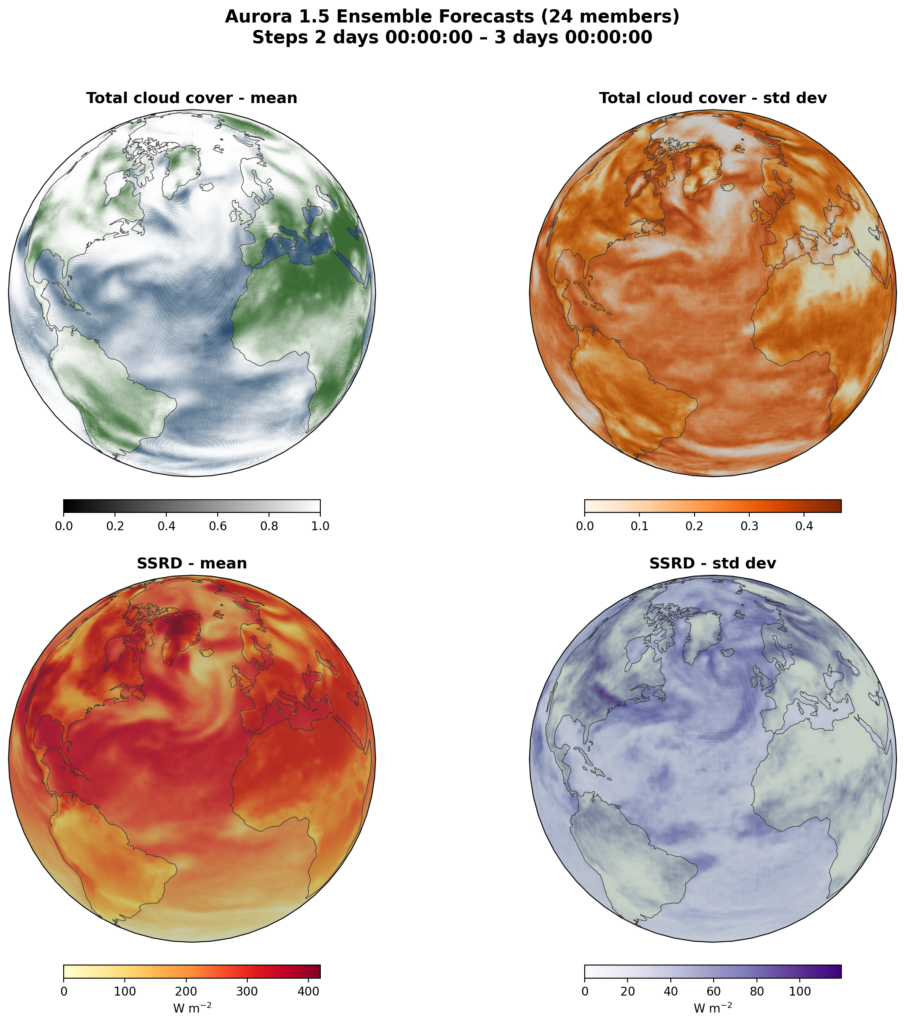
We present Aurora 1.5, a fine-tuned variant of the Aurora atmospheric foundation model [Bodnar
et al., 2025] optimized for skillful medium-range ensemble weather prediction. Building on Aurora’s
pretraining across diverse heterogeneous atmospheric data, we introduce a three-stage fine-tuning
pipeline that (i) expands the single-level variable set and randomizes lead-time embeddings to enable
a native one-hour temporal resolution, (ii) injects Gaussian noise into AdaptiveLayerNorm (AdaLN)
modules to generate stochastic forward passes and optimizes a Continuous Ranked Probability Score
(CRPS) objective in place of a deterministic loss, and (iii) performs auto-regressive fine-tuning on
operational ECMWF analyses with multi-step rollouts. Aurora 1.5 ENS outperforms the ECMWF
ENS operational ensemble on 88.9% of upper-air and single-level target variables in the medium range
(days 1–10). Reliability diagnostics including rank histograms indicate that Aurora 1.5 ENS achieves
this result with a slight over-dispersion, in contrast to the under-dispersion typical of dynamical
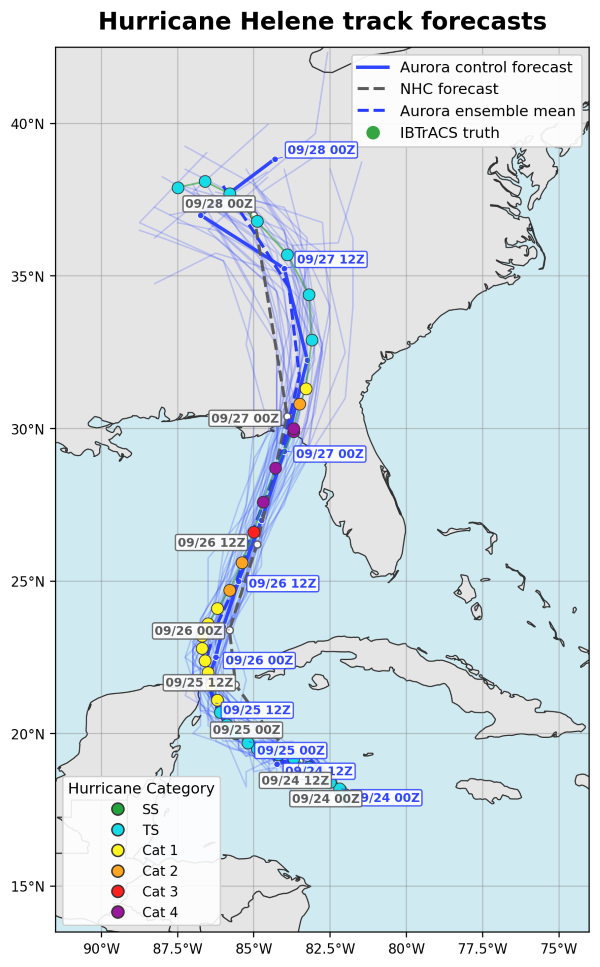
models. Compared to Aurora, Aurora 1.5 also better predicts extreme events, reducing tropical
cyclone track errors by 16% and the mean absolute error on top-5th percentile heat waves by 58%.
Aurora 1.5 demonstrates that foundation model fine-is a viable, cost-effective path toward
reliable probabilistic AI weather prediction.