
The bar for AI in financial services is rising faster than any technology adoption in the history of our industry. Today, execution at scale is the defining challenge, and the leaders will be those who effectively embed AI across their businesses to help drive revenue, manage risk, and shape client outcomes. Competitive advantage in the AI era will come less from access to models and more from a firm’s ability to continuously learn from its proprietary data, orchestrate human and agent collaboration, and operate a secure, governed AI platform.
The shift is already underway. Major financial institutions are quickly moving beyond limited use cases toward agentic AI solutions designed to help drive impact at scale. Frontier Firms—organizations reimagining business processes around human-agent collaboration—are integrating intelligence into the workflows, data environments, and governed systems where decisions are made and work gets done.
The challenge is that in the heavily regulated constraints of financial services, access to data is tightly controlled, critical data is often fragmented across legacy platforms, and workflows span multiple systems, teams, and jurisdictions. Internal data must be integrated with external data, including market data, research, and third-party insights. Firms must be certain that the right people can access the right data in the right ways, while keeping it all safe.
Our partnership with Microsoft is shaping the next era of AI ready data and intelligence‑driven workflows. We are meeting clients where they work—embedding S&P Global’s trusted, high‑quality data directly into their workflows and unlocking agentic capabilities that turn insight into action, enabling accurate, faster, more-informed decision‑making. Together, we are accelerating how clients drive growth, manage risk, and capture opportunity in an increasingly complex and fast‑moving market.
Sally Moore, Chief Client Officer, S&P Global
Trust is paramount, and the best way to scale AI is to leverage the inherent strengths and attributes of a trusted cloud environment and the applications that professionals use to do their work. This way, data used in agentic solutions can be configured to inherit existing permissions, licensing constraints, and governance controls, rather than requiring firms to rebuild trust around new layers.
This requires viewing AI as an operating capability that unifies data, governance, tools, and workflows, enabling intelligence to show up where work happens. Approaches that simplify access to critical data and embed AI into everyday decisions and actions are best positioned to succeed.
Putting AI at the point of work—where data, decisions, and action come together
Financial work rarely happens in a single system. Professionals move across data, spreadsheets, meetings, messages, and business applications, in scenarios that span all aspects of financial services. To name just a few:
- A banker preparing for a client meeting needs more than a market summary; they need relevant signals, prior context, comparable activity, potential risks, and a path to the next best action.
- A risk professional needs intelligence that can be applied within existing controls, not outside them.
- An investment analyst needs current financial data in the spreadsheet where assumptions are being tested, not a separate answer that has to be copied and reconciled later.
AI creates more value when it is embedded in workflows across the value chain, helping to reduce handoffs, preserve context, and close the gap between analysis and action. AI that sits apart from the workflow can generate useful responses, but it still requires that data be copied, reconciled, and validated across systems.
The next phase of AI in financial services is about connected intelligence that brings the right data into the right context at the right moment. Our connectors ensure Morningstar’s independent research and trusted data sit alongside firms’ own data within their workflows, enabling investment professionals to generate deeper insights, move with greater speed, and make more confident decisions with clarity and control across the entire investment process.
Adam Wheat, Chief Technology Officer for Direct Platform, Morningstar
Our focus is to narrow the distance between trusted information, professional judgment, and the action that follows—in other words, to enable governed AI execution in context, allowing people to move from insight to action within familiar tools. This is why we, and our partners, are bringing financial data and AI capabilities directly into the everyday applications and tools many professionals use to get work done, including Microsoft Excel, Teams, Outlook, and Microsoft 365 Copilot. It enables intelligence that can be accessed in the spreadsheet where analysis is being built, in the meeting where a client discussion is being prepared, or in the collaborative space where teams coordinate the next step.
The platform for advanced AI experiences
For financial institutions, the next model for AI begins with the data that anchors the business: market intelligence, risk signals, research, client information, transaction context, policies, and operational knowledge.
Microsoft’s approach brings together trusted data, enterprise context, and intelligence on one integrated platform. It spans a rich ecosystem of financial services data providers, helps to orchestrate models, and is built upon the core strengths of the Microsoft Cloud: enterprise-grade security, compliance, and governance.
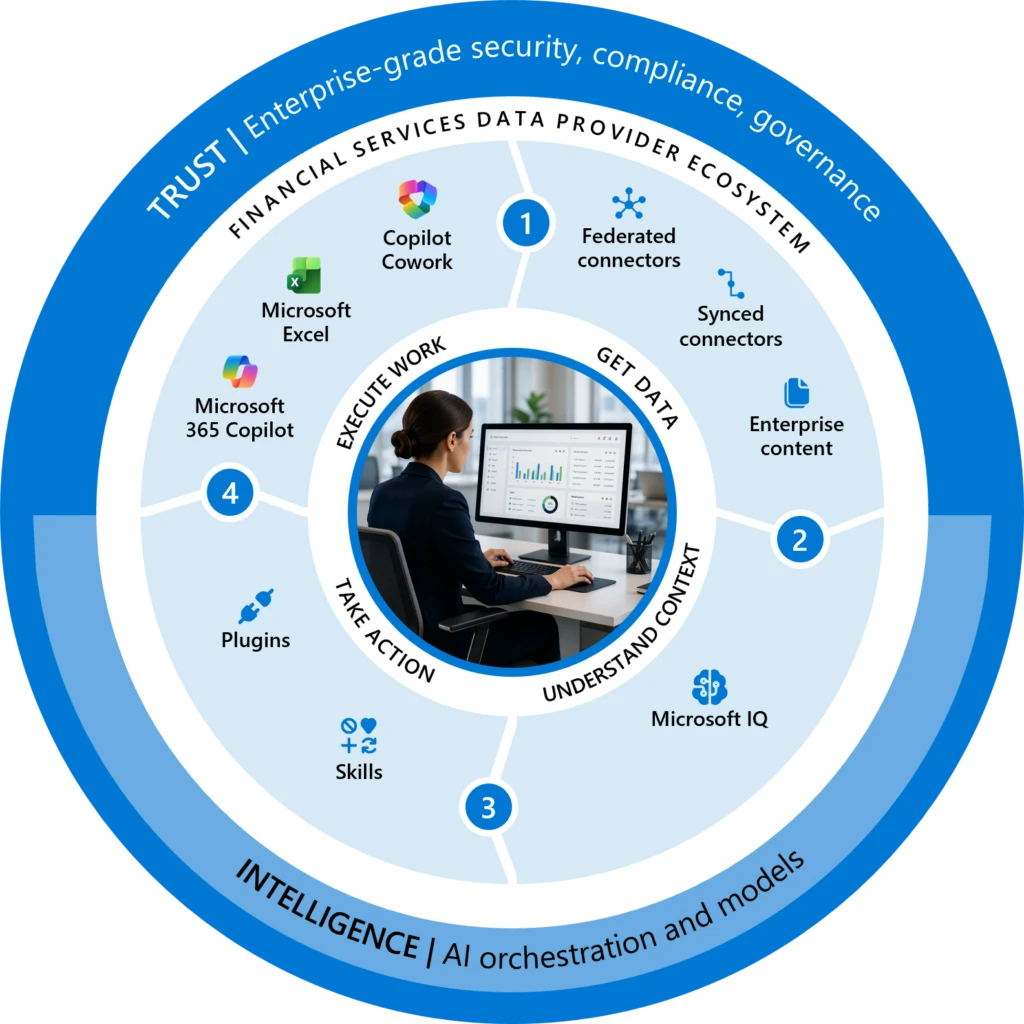
In this approach, the following key features work together to connect trusted data, enterprise context, and AI-powered capabilities:
- Federated connectors provide live data by accessing information without moving or copying it.
- Synced connectors provide enterprise data by indexing content from business and partner systems.
- Microsoft IQ provides context by understanding how people work, how the business operates, what the organization knows, and how the broader business and market environment is changing.
- Skills provide expertise by defining how specific business tasks are performed.
- Plugins combine connectors and skills to package data access and task expertise into reusable capabilities.
- Copilot Cowork helps coordinate and assist with tasks across systems, people, and workflows—bringing agentic capabilities into Microsoft 365 Copilot and, by extension, into Excel, Word, PowerPoint, and Outlook.
Together, these features empower financial services professionals to ask more precise questions, receive more relevant answers, and take action directly within their workflows, all while supporting compliance efforts and helping preserve context.
Expanding the ecosystem of financial data providers
In recent months, we’ve unveiled this strategy through milestones that reveal an expanding ecosystem of financial data providers and capabilities.
Federated Copilot connectors extend Copilot’s reach by securely integrating external real-time data directly into Copilot in Excel, Copilot Chat, and Researcher agent. Recently, we announced federated Copilot connectors from LSEG and Moody’s, and the momentum continues today with new federated Copilot connectors from CB Insights, Daloopa, FactSet (in preview), Morningstar, PitchBook, and S&P Global. Together, these integrations can provide access to up-to-date market data, company intelligence, research, portfolio analytics, investment data and more—within supported workflows, subject to provider availability, licensing, and system integration.
As financial institutions scale AI, the combination of trusted data and enterprise platforms becomes critical. Our collaboration with Microsoft enables clients to bring LSEG’s data into AI-powered workflows, supporting more consistent, informed decision-making across their business.
Emily Prince, Group Head of Enterprise AI, LSEG
Copilot Cowork plugins embed specialized partner expertise directly into task-oriented workflows, enabling Copilot to support role-specific financial analysis and decision-making. Building on the recent launch of Copilot Cowork plugins from LSEG and S&P Global Energy, we’ve now expanded the list of partners with Copilot Cowork plugins from CB Insights, Moody’s, Morningstar, and PitchBook. These plugins package proprietary data, models, and domain knowledge within defined workflows, depending on partner capabilities and implementation, allowing financial services professionals to move more readily from insight to action.
The defining question for financial institutions today isn’t whether to use AI, it’s whether they can trust the intelligence powering it. From Microsoft 365 Copilot to Excel to Copilot Cowork, Moody’s is embedding its decision-grade connected intelligence directly into the Microsoft workflows where consequential decisions are made every single day, allowing our customers to move with greater confidence and speed without sacrificing the rigor, transparency and accountability that high-stakes decisions demand.
Cristina Pieretti, Head of Digital Content and Innovation, Moody’s
We’ve also announced new skills and capabilities for Copilot in Excel, one of the most widely used tools in financial services. In addition, we’ve introduced a starter library of pre-built finance skills, alongside the ability for organizations to create and integrate their own. Combined with new customization and control features, these enhancements enable financial services professionals to customize their workflows, apply consistent logic, and scale analysis more efficiently.
This integrated platform supports a shift from information retrieval to governed execution. For firms and institutions, this can mean more efficient preparation, more consistent use of trusted information, less manual stitching across applications, and a stronger connection between insight and execution.
Trust as the foundation
For financial institutions, this shift can only succeed if trust is built into the architecture. Organizations must be able to innovate without separating intelligence from the controls that make enterprise adoption possible.
This is where Agent 365 makes the trust model tangible. It lets organizations see which agents are operating, understand what data they are using, monitor the actions they take, and apply policies that govern how they work. It also supports the traceability and citations institutions require to understand how data was used, what sources informed an output, and how agent-driven work was generated.
As agentic workflows become the new standard for how analysis gets done, the data underneath must be trustworthy and verifiable. Through Kensho’s AI innovation and S&P Global’s domain expertise, we’ve done that work, creating a trusted data retrieval foundation designed for how AI systems reason and act. Our partnership with Microsoft is about bringing that foundation into the AI-native experiences where the industry is already headed.
Bhavesh Dayalji, Chief AI Officer, S&P Global and CEO, S&P Kensho
The same environment that brings data and AI closer to work should inherently provide the capabilities required to use agents responsibly at scale. In regulated industries, this combination is a material advantage: firms should not have to choose between moving faster with AI versus maintaining control over how data and actions are managed.
For financial services leaders, the next phase of AI will not be defined by isolated experiments, disconnected tools, or AI architectures that require firms to add a separate layer of trust, permissions, and context on top of the systems they already use. As firms move from experimentation to scaled adoption, Microsoft’s advantage is the ability to combine trusted data, context, workflow integration, and governance in one coherent operating model for AI, allowing firms to leverage the platforms they already depend on.
Learn more
- Learn how agentic AI is rearchitecting asset management at scale.
- For a practical framework on using AI to drive coordinated, enterprise-scale impact across the firm, read Frontier Transformation in Capital Markets.
- Visit Microsoft for Financial Services to learn more about how Microsoft empowers financial services organizations to achieve more.