À propos
Spencer Fowers is a Principal Researcher in the Catalyst Lab at Microsoft Research Redmond. He joined Microsoft in 2012, where his work has spanned systems, AI, and large-scale applied research, with a consistent focus on taking cutting-edge ideas from prototype to real-world impact.
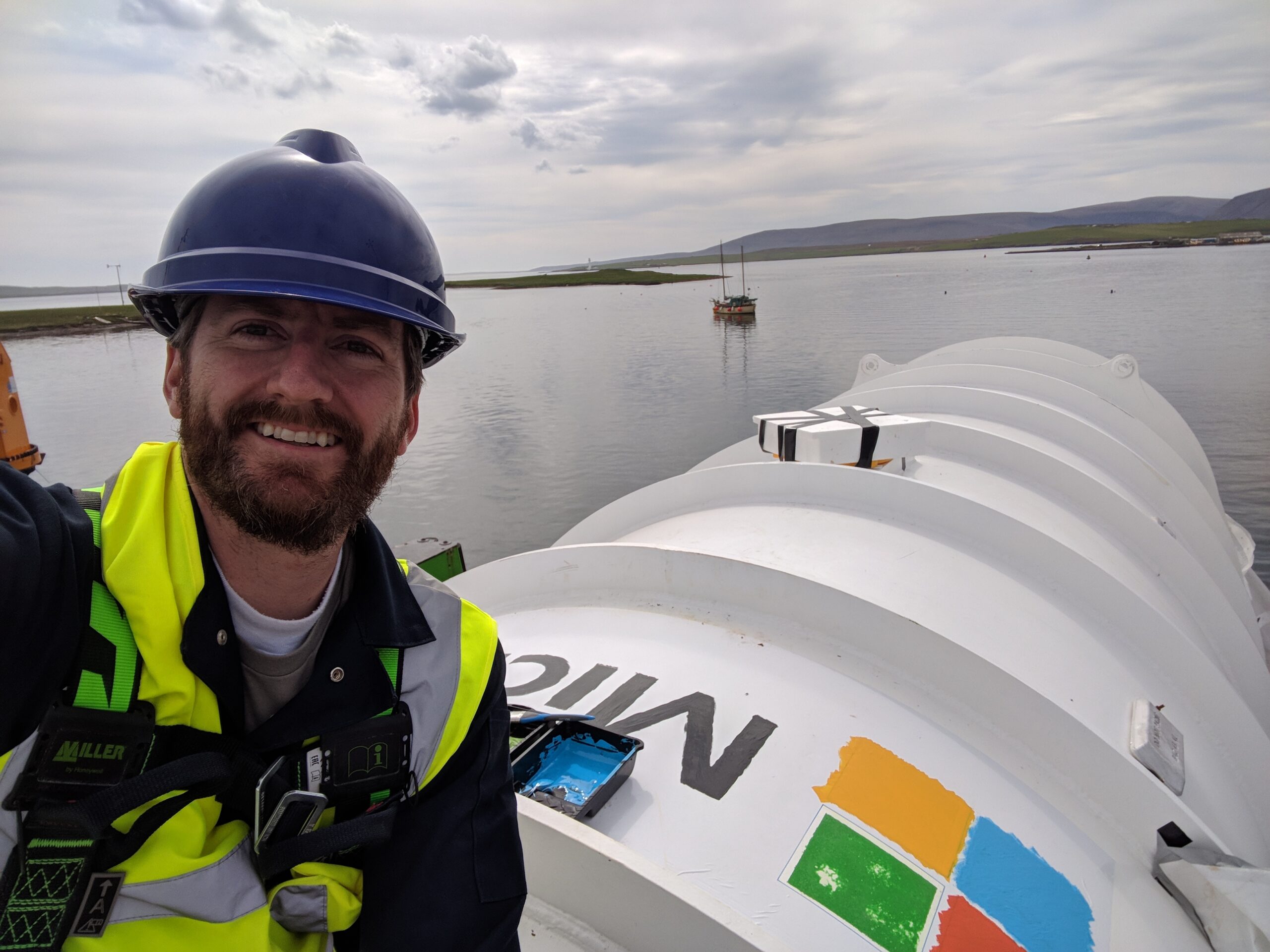
Spencer painted the Microsoft logo on the Natick Northern Isles datacenter
Spencer’s current research centers on advancing AI-driven systems for complex, real-world domains, with a particular emphasis on
power grid modeling and optimization. His work explores how machine learning—especially generative and foundation models—can accelerate and improve the solution of structured, physics-constrained problems such as AC Optimal Power Flow (ACOPF). He has contributed to the development of neural and generative approaches to grid modeling, enabling faster, more scalable, and more robust decision-making for modern energy systems.
In parallel, Spencer is actively developing agentic AI systems that integrate large language models with tools, simulations, and persistent knowledge graphs. His work in this area focuses on building reliable, composable AI agent swarms that can plan, reason, and execute complex workflows across domains such as research synthesis, software development, and data generation.
Spencer has also played a key role in advancing data-centric AI workflows, including large-scale synthetic data generation and benchmarking pipelines. His projects combine high-performance computing with modern ML techniques to generate training data, evaluate model capabilities, and enable reproducible experimentation at scale.
His most recent completed project is 3D Telemedicine which is based on Holoportation(TM). He helped move Holoportation from a high-bandwidth studio experience to a mobile platform running in the back of a car, and from there to the back of a van in Western Africa! This work focused on live volumetric capture of a patient and transmission of the compressed data anywhere in the world. The randomized crossover trial performed in the UK during COVID with 3D Telemedicine received the Top Paper award at BAPRAS (opens in new tab) 2024. The work was open-sourced in December of 2025, and is now available on GitHub (opens in new tab).
In addition, Spencer continues to advise on Project Natick (opens in new tab), and communicate to the public about the benefits of underwater datacenters. He was the lead engineer for the project and has worked at all levels from day-to-day IT operations, up to system design and subcontractor interfacing. He even painted the logos on Natick Northern Isles himself!
Spencer’s interests broadly span AI for science, agentic systems, foundational models, computer vision, sensor integration, robotics and the intersection of machine learning with structured optimization and simulation. Spencer holds a Ph.D. in Electrical and Computer Engineering from Brigham Young University.
S’ouvre dans un nouvel onglet