Reinforce Adjoint Matching: Scaling Diffusion RL
- Andreas Bergmeister, TU Munich
- Microsoft Research New England Generative Modeling & Sampling Seminar
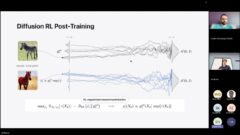
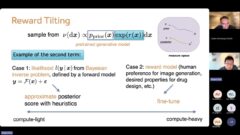
Diffusion and flow-matching models scale because pretraining is supervised regression: a clean sample is noised analytically, and a model regresses against a closed-form target. RL post-training aligns the model with a reward. In image generation, this makes samples compose objects correctly, render text legibly, and match human preferences. Existing methods rely on costly SDE rollouts, reward gradients, or surrogate losses, sacrificing pretraining’s regression structure. We show that the structure extends to RL post-training. Under KL-regularized reward maximization, the optimal generative process tilts the clean-endpoint distribution towards samples with higher reward and leaves the noising law unchanged. Combining this with the adjoint-matching optimality condition and a REINFORCE identity, we derive Reinforce Adjoint Matching (RAM): a consistency loss that corrects the pretraining target with the reward. At each step, we draw a clean endpoint from the current model, evaluate its reward, noise it as in pretraining, and regress. No SDE rollouts, backward adjoint sweeps, or reward gradients are required. Like the pretraining objective, RAM is simple and scales. On Stable Diffusion 3.5M, RAM achieves the highest reward on composability, text rendering, and human preference, reaching Flow-GRPO’s peak reward in up to 50× fewer training steps.
Speaker bio
Andreas Bergmeister is a PhD student at TU Munich. He received his Bachelor’s and Master’s degrees in Computer Science from ETH Zurich. His research focuses on generative models, diffusion models in particular.

Series: MSR New England Generative Modeling & Sampling Seminar
-
-

Inferring Unobserved Trajectories from Multiple Temporal Snapshots
- Yunyi Shen & Carles Domingo-Enrich
-
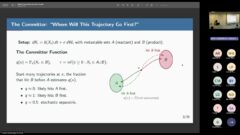
Rare event analysis via stochastic optimal control
- Yuanqi Du & Carles Domingo-Enrich
-
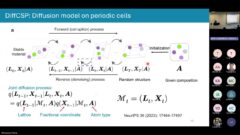
Constrained Generative AI for Materials Inverse Design
- Mouyang Cheng
-
-
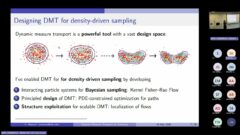
Designing Dynamic Measure Transport for Sampling
- Aimee Maurais
-
-
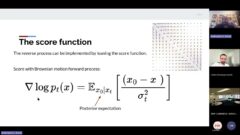
Physics and information theory of generative diffusion
- Luca Ambrogioni
-
-
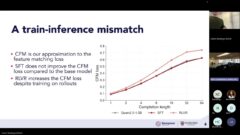
Matching features, not tokens: Energy-based fine-tuning of language models
- Mujin Kwun,
- Carles Domingo-Enrich
-
-
-

Generative Models for Molecular Dynamics Across Timescales
- Michael Plainer,
- Winfried Ripken,
- Gregor Lied
-
-
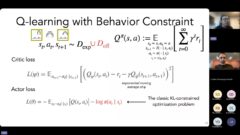
Q-learning with Flow-Matching Policies
- Qiyang (Colin) Li
-
-
-
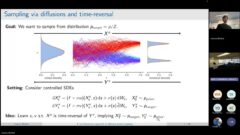
A non-Markovian approach to diffusion-based sampling
- Lorenz Richter
-

Blind denoising diffusion models and the blessings of dimensionality
- Aram-Alexandre Pooladian
-

Meta Flow Maps
- Peter Potaptchik