Expanding Flows for Fast and Flexible Generation Beyond the Fixed Canvas
- Sophia Tang, University of Pennsylvania
- Microsoft Research New England Generative Modeling & Sampling Seminar
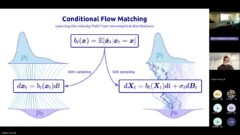
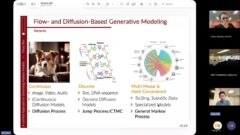
Flow-based generative models have enabled remarkable progress in fast and controllable generation across continuous and discrete state spaces, yet existing parameterizations are constrained to fixed dimensions or fixed sequence lengths. In this talk, I will present a framework that lifts flow-based modeling out of this fixed-canvas regime by treating output size as a learned degree of freedom. I will begin by introducing Expanding Generative Flows (EFlows), which define flows between distributions of increasing dimensionality through an expanding interpolant built from augmented distributions of conditional noise. Building on this foundation, I will introduce Expanding Flow Maps (EFMs), a class of flow maps that distill EFlows into efficient few-step generative models. The central idea is to decompose the map between any two time steps into two learned components: an expand operator that augments the state with new coordinates or tokens, and a transport map that pushes the expanded state, with local time coordinates, forward along the interpolant. Composing these operators yields a single map that jointly expands and denoises the state, recovering existing fixed-canvas flow maps as the special case where the expand operator is the identity. I will then show how the framework extends to the discrete simplex, enabling variable-length sequence generation through token insertions. Together, EFlows and EFMs offer a principled approach to generative problems in which the size of the output is itself something to be controlled and learned, rather than fixed in advance.
Speaker bio
Sophia Tang is a researcher at the University of Pennsylvania, advised by Dr. Pranam Chatterjee, and is currently a visiting researcher at the Kempner Institute at Harvard University. Her research spans multiple areas of AI for science and generative modeling, with prior work in multi-objective RL and guidance techniques for discrete diffusion to theoretical Schrödinger bridge frameworks for generative modelling of branching and interacting particle systems. More about her work can be found at https://sophtang.github.io/ (opens in new tab).
Series: MSR New England Generative Modeling & Sampling Seminar
-
-
-
-
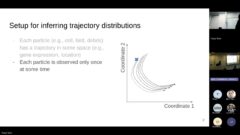
Inferring Unobserved Trajectories from Multiple Temporal Snapshots
- Yunyi Shen & Carles Domingo-Enrich
-
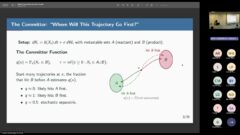
Rare event analysis via stochastic optimal control
- Yuanqi Du & Carles Domingo-Enrich
-
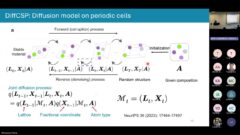
Constrained Generative AI for Materials Inverse Design
- Mouyang Cheng
-
-
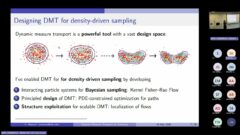
Designing Dynamic Measure Transport for Sampling
- Aimee Maurais
-
-
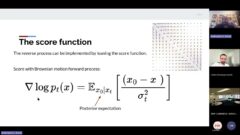
Physics and information theory of generative diffusion
- Luca Ambrogioni
-
-
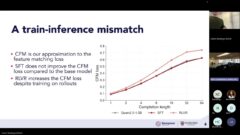
Matching features, not tokens: Energy-based fine-tuning of language models
- Mujin Kwun,
- Carles Domingo-Enrich
-
-
-
Generative Models for Molecular Dynamics Across Timescales
- Michael Plainer,
- Winfried Ripken,
- Gregor Lied
-
-
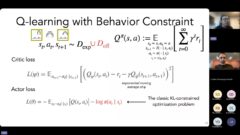
Q-learning with Flow-Matching Policies
- Qiyang (Colin) Li
-
-
-
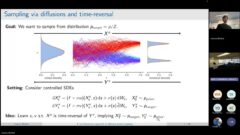
A non-Markovian approach to diffusion-based sampling
- Lorenz Richter
-
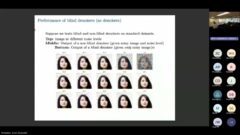
Blind denoising diffusion models and the blessings of dimensionality
- Aram-Alexandre Pooladian
-

Meta Flow Maps
- Peter Potaptchik